
Not-for-Profit record retention is a lot more than an administrative task. Having a record retention policy is foundational for compliance requirements, transparency, and mitigating various risks. Creating and maintaining a sound retention policy helps Organizations operate responsibly and establishes strong trust and relationships with board members and donors. Finally, making sure you have all the necessary records makes the annual audit process significantly smoother.
We’ve compiled some of the most common questions we get from Not-for-Profit clients on record retention below. Reference this as a handy checklist for best practices.
What are the Most Important Records to Keep, and How Long Should I Keep Them?
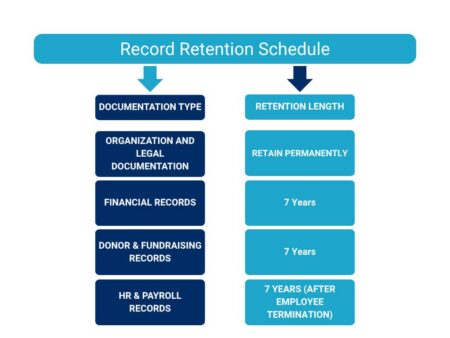
Organizational and Legal Documentation – Retain Permanently
- This includes things such as Articles of Incorporation and Bylaws, IRS Determination Letter and State Registration Documents. As a Not-for-Profit, it is vital to maintain documentation of your Organization’s legal standing and history.
- These documents should be retained permanently for legal and regulatory compliance purposes as proof that your Organization is legally established and maintaining their authorized purpose. In addition, it is important for maintaining tax-exempt status if the Organization ever needs to prove their eligibility.
Financial Records – 7 years
- General financial records include general ledger details, bank statements and reconciliations, and budgets.
- Tax records include 990 filings and payroll tax filings, as well as documentation for these filings.
- Financial supporting documentation includes invoices, receipts, and grant financial reports (as required by grants received).
Donor and Fundraising Records – 7 years
- These records include things such as donor contribution history, gift acknowledgment and receipts, and grant agreements.
HR and Payroll Records – 7 years (after employee termination as applicable)
- Employee records retained include personnel files, employment contracts and performance evaluations.
- Payroll and Benefit records include time sheets, benefit plan documentation and period end payroll reports.
- Additional HR records include I-9 forms and any worker’s compensation or incident reports
What Should an Organization do with Records After the Retention Period?
- As part of an Organization’s retention policy practices, a destruction policy process should be included with details on how physical documentation will be securely shredded and disposed of and how digital documentation will be properly deleted.
What Risks Can I Mitigate by Having a Retention Policy in Place?
Regulatory Compliance
- As a Not-for-Profit Organization, you are subject to various federal, state and local regulations. Maintaining proper record retention ensures that the Organization is in compliance with IRS requirements, audit reporting obligations, and tax-exempt status.
Financial Accountability and Transparency
- Not-for-Profit Organizations must depend on donors, grantors and public trust to continue operations. Retaining financial records allows an Organization to provide a clear explanation of where funds are coming from and how those funds are used, supports financial reporting during a financial audit, and builds credibility with donors and grantors.
Organizational Continuity
- Retaining proper records helps ensure that during periods of turnover, new leadership is able to transition more smoothly into the Organization with all policies and organizational history readily available to them.
Grant and Funding Requirements
- Many grants that are received by Not-for-Profit Organizations require records to be maintained, as well as some sort of annual reporting to be provided to the grantors. By maintaining proper records, an organization can support their compliance with grant requirements, enable easier and more accurate reporting on outcomes and impacts, as well as help to secure future funding.
Overall Operational Efficiency
- Having a sound retention policy improves leadership’s access to important documents, reduces unnecessary clutter and the need to store additional paperwork, and ensures that all staff follows a consistent process and understand what needs to be saved and how to properly dispose of what doesn’t.
Olsen Thielen is a long-time accounting and advisory partner to Not-for-Profit Organizations. If you have any questions on how to create and enforce a strong record retention policy at your organization, we would be happy to discuss how we can work together to implement a process that best fits you and your Organization’s needs.
Reach out to Not-for-Profit advisory specialist Kiya Ramsingh to get the conversation started.